
Gold restorations have a proven long term success rate when the tooth is prepared appropriately (94% over a 40yr period according to Tucker et al.) Considering gold restorations is therefore something that we will continue to consider providing in practice and when discussing patient options with a long term outlook in planning.
This module had us practice preparations for 3/4, 7/8, full and onlay gold crown preparations. This presents a wide range of techniques that can be best applied to the clinical scenario.


A systematic approach to all these preparations was reinforced, starting with occlusal reduction which is dependent on the presenting occlusion. Depth cuts (0.3mm-0.75mm) and keeping the correct occlusal inclination is important. Next the preparation of the appropriate functional cusp bevel to create an additional 0.5mm of space in this loaded area was practiced. This was done at 45 degrees to the occlusal plane. Depending on the preparation type, margins were prepared to create a 0.5mm chamfer.
When preparing for 3/4, 7/8 and gold onlay preps grooves can be incorporated to provide retention and resistance and structural durability. For the 3/4 gold prep and onlay prep an occlusal bevel should be incorporated to improved marginal integrity.
Key features of each of the preparation types is as follows and provides a template from which we work when providing these treatments in the mouth:
3/4 gold
Planar occlusal reduction for structural durability
Occlusal offset for structural durability
Facial finishing bevel for marginal integrity
Proximal flare for marginal integrity
Proximal groove for retention and resistance and structural durability
Chamfer finish line for marginal integrity and periodontal preservation just surpagingival.
Axial reduction for retention and resistance and structural durability.
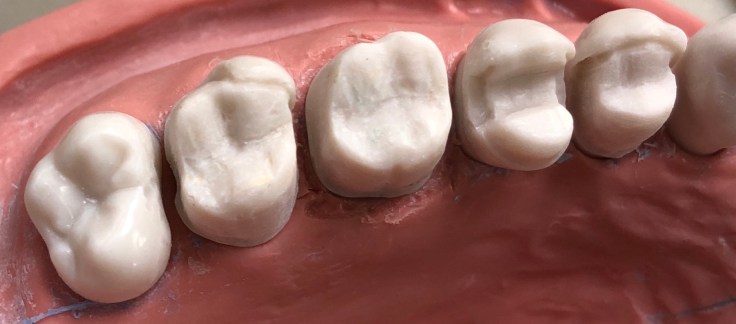
Gold Onlay
Planar occlusal reduction for structural durability
Occlusal facial bevel – marginal integrity
Proximal flare
Proximal box for structural durability and resistance and retention form.
Gingival bevel for marginal integrity
Occlusal lingual bevel for marginal integrity
Occlusal shoulder for structural durability
Functional cusp bevel for structural durability
Isthmus for resistance and retention form and structural durability.
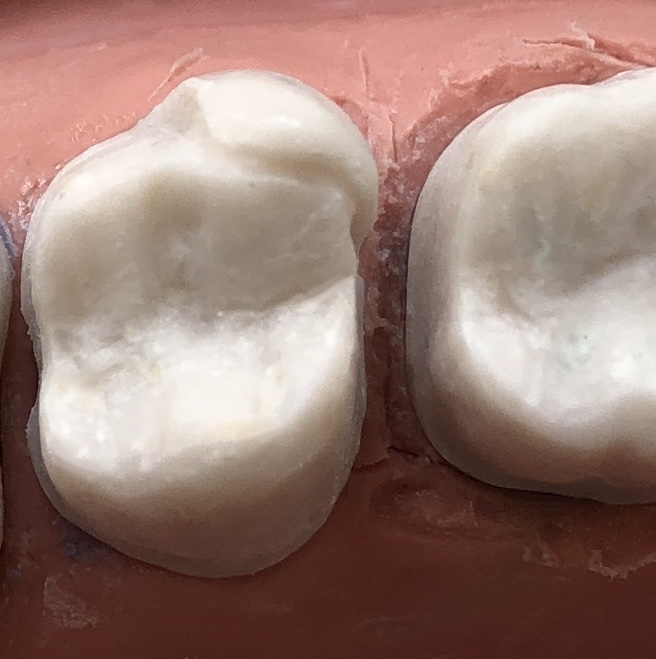
7/8 Prep
Preservation of the MB cusp.
Planar occlusal reduction
Functional cusp bevel
Axial reduction and chamfer finish line
Flare for marginal integrity and facial groove for resistance and retention form and structural durability
Occlusal finishing bevel for marginal integrity and a mesial groove for additional resistance and retention form.
Occlusal offset for structural durability.
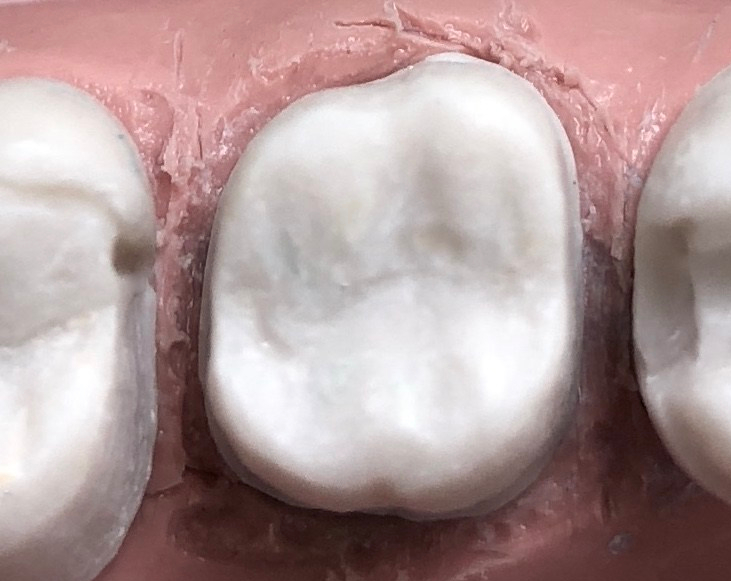
FGC
Planar occlusal reduction (8 planes) with depth cuts 0.75mm and finish to 1mm. Manintain cuspal shape.
Functional cusp bevel
Proximal and axial reduction with chamfer finish line just supragingival 0.5mm.
These preparation parameters provide the framework from which we deliver gold preparations and restorations in clinic. They offer a versatile and long term treatment option in the appropriate scenario and can be utilised for single unit or in planned multiple unit rehabilitation including bridge work as part of fixed-fixed (periodontally involved abutments) or in fixed moveable restorations where periodontal support is not affected.
 Performance Smiles®
Leave a comment