

Part 3 of the PG Cert in Operative Dentistry
All Ceramic Crowns
- Porcelain Crown preparation
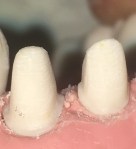
The reduction for a dentine bonded crown is 0.5mm -0.7mm (i.e for feldspathic porcelain) and 0.75mm -1mm for castable glass ceramic. Reinforcement of use of a putty matrix to guide depth and tooth tissue removal was achieved and checked in 3 planes. Measuring bur thickness is now routine. The cervical reduction differs dependent on the tooth being prepared with a lateral having a greater thickness of enamel than a canine. UL2 was prepared with a 0.3mm gingival margin. Once cut through interproximally, the overall convergence angle should be 20-30degrees with an axial inclination of 10-15 degrees. A 0.5mm chamfer is created mesially and distally. Palatal preparation utilised depth grooves and 0.5-0.7mm removed using a round rugby shaped bur to reduce the palatal cingulum. A palatal 0.5mm supragingival chamfer margin was created. It was important to ensure all line angles were rounded to prevent thin sections of porcelain being cast and later fracturing away during manufacture or cementation.
- Procera Crown Preparation
Procera crowns require 1.0-1.2mm reductions. Depth grooves labially are prepared at 1mm thickness with 2-3mm incisal reduction. Checks were again made with a putty matrix as interproximal and palatal reductions were completed. During the final marginal preparation one retraction cord was packed and the margin was then finished to this cord. The second thicker cord was placed before recording the final impression. Procera are cemented restorations where a RMGI such as Fugji plus can be utilised. Porcelain restorations on the other hand should ideally be fitted using resin bonded techniques. I tend to use Nexus in practice. The session provided the opportunity to refine our impression techniques using PVS and a light body material. Again by lightly airblowing the light body with 3 in1 allowed better flow into the sulcus to capture detail and reduce the chace of incorporating bubbles before placing the PVS filled tray.
Inlays and Onlays
- Inlays
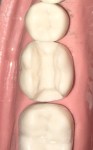
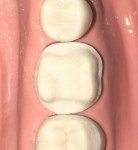
The importance of correct cavity design to incorporate 10-15 degree axial walls, a 2mm flat or concave depth of cavity and ensuring internal line angles are rounded. Cavo surface margins need to avoid cuspal contacts. The opposing contacts need to be on porcelain or enamel, not on the margin. Care is to be taken to keep margins 1mm away from opposing tooth contacts. A hollow ground chamfer creates a more effective seal for the restoration and improves aesthetic colour blending. A hollow-ground chamfer is confined to the enamel and developed with a microfine diamond C.I.P no. 4 bur.
- Onlays
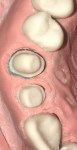
Where the cavity walls reach the cusp tips or if the cusps are undermined – they then required capping. Cusps to be capped are reduced by 2mm ensuring rounded lines angles. A 1mm wide deep chamfer buccally 1mm below the contact with the opposing tooth was prepared on the LR6. It was ensured there were no steps around the margin of the preparations. An extra 0.5mm functional cusp bevel off the lower buccal cusps at 45 degrees to the long axis of the tooth was prepared. All cusps were rounded so there were no sharp edges.
 Performance Smiles®
Leave a comment